About the book:
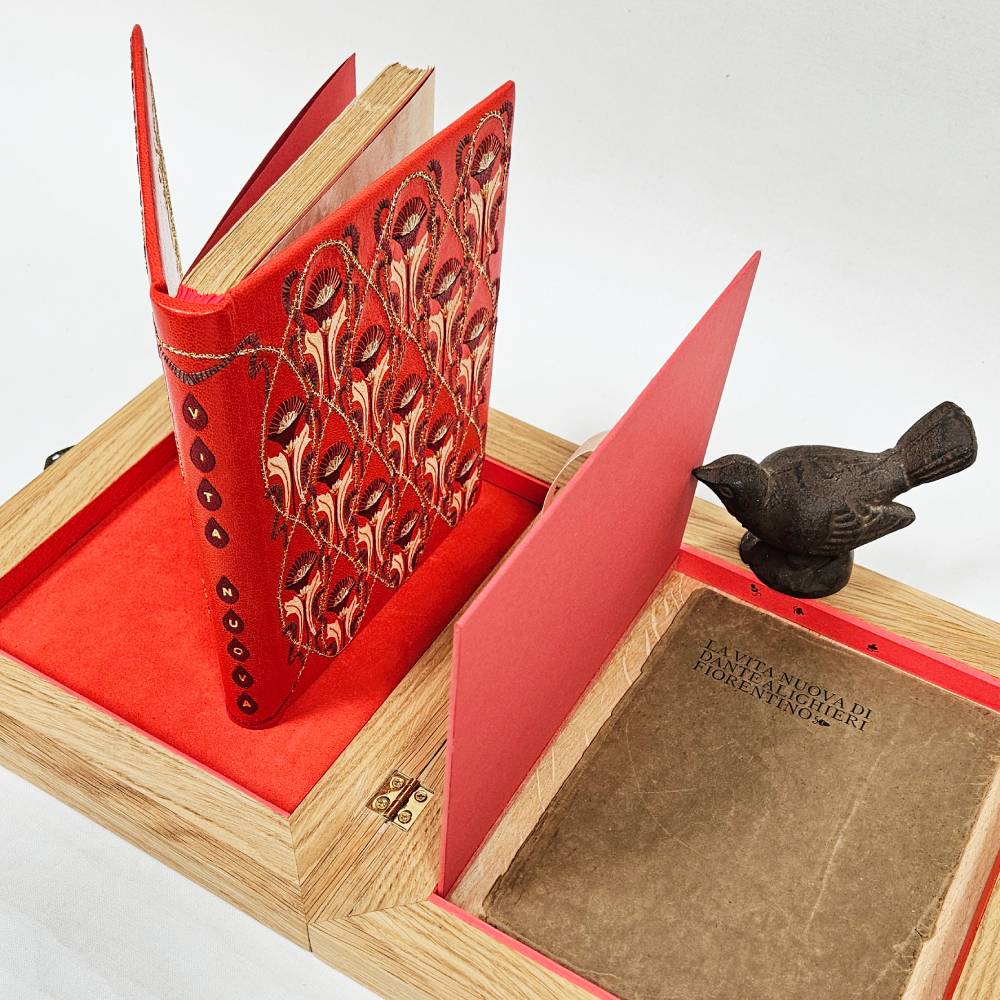
This copy of Dante Alighieri’s La Vita Nuova di Dante was published by The Ashendene Press in 1895 and is one of forty-five copies printed on Japanese vellum.
The Ashendene Press was a small private press founded by St John Hornby (1867–1946). It operated from 1895 to 1915 in Chelsea, London and was revived after the war in 1920. The press closed in 1935. Its peers included the Kelmscott Press and the Doves Press. Hornby became friends with William Morris and Emery Walker, who helped inspire his work. These three presses were part of a “revival of fine printing” that focused on treating bookmaking as fine art. The Ashendene Press was famous for producing high-quality works by Dante. Ashendene books had excellent bindings and focused more on pleasure than reform than the other private presses of the time, though one review claims that the Ashendene Press was the most successful private press in recapturing the essence of fifteenth-century printing. Ashendene books were carefully printed with large margins, and despite their lack of extravagant decoration, they were considered spectacular works of art. Two original typefaces were created for the Ashendene Press: Subiaco and Ptolemy. They were known for handwritten, colored initials by Graily Hewitt. The press’ main customers were book collectors who paid for a subscription for Ashendene books.
La Vita Nuova di Dante was the first in a splendid line of Italian books to be printed by St John Hornby and only the second book of the Press. Written in the vernacular Tuscan, and in the prosimetrum style, the Vita Nuova is a totally unique poetic treatise marking Dante’s attempt to reveal the sacred element underlying love poetry in this series of verse, written across several styles, that express the poet’s love for Beatrice Portinari.
Dante Alighieri was born in Florence in 1265 and belonged to a noble but impoverished family. He met Beatrice, who was to be his muse, in 1274, and when she died in 1290 he sought distraction in philosophy and theology, and wrote La Vita Nuova. He worked on the Divine Comedy from 1308 until near the time of his death in Ravenna in 1321.
The poems themselves tell the story of his undying love for Beatrice, from their first meeting at a May Day party, through Dante’s sufferings and his attempts to conceal the true object of his devotion, to his overwhelming grief at her death, and ending with the transformative vision of her in heaven. These are some of the richest love poems in literature and the movement from self-pitying lament to praise for his beloved’s beauty and virtue illustrate the elevating power of love.


About the binding:
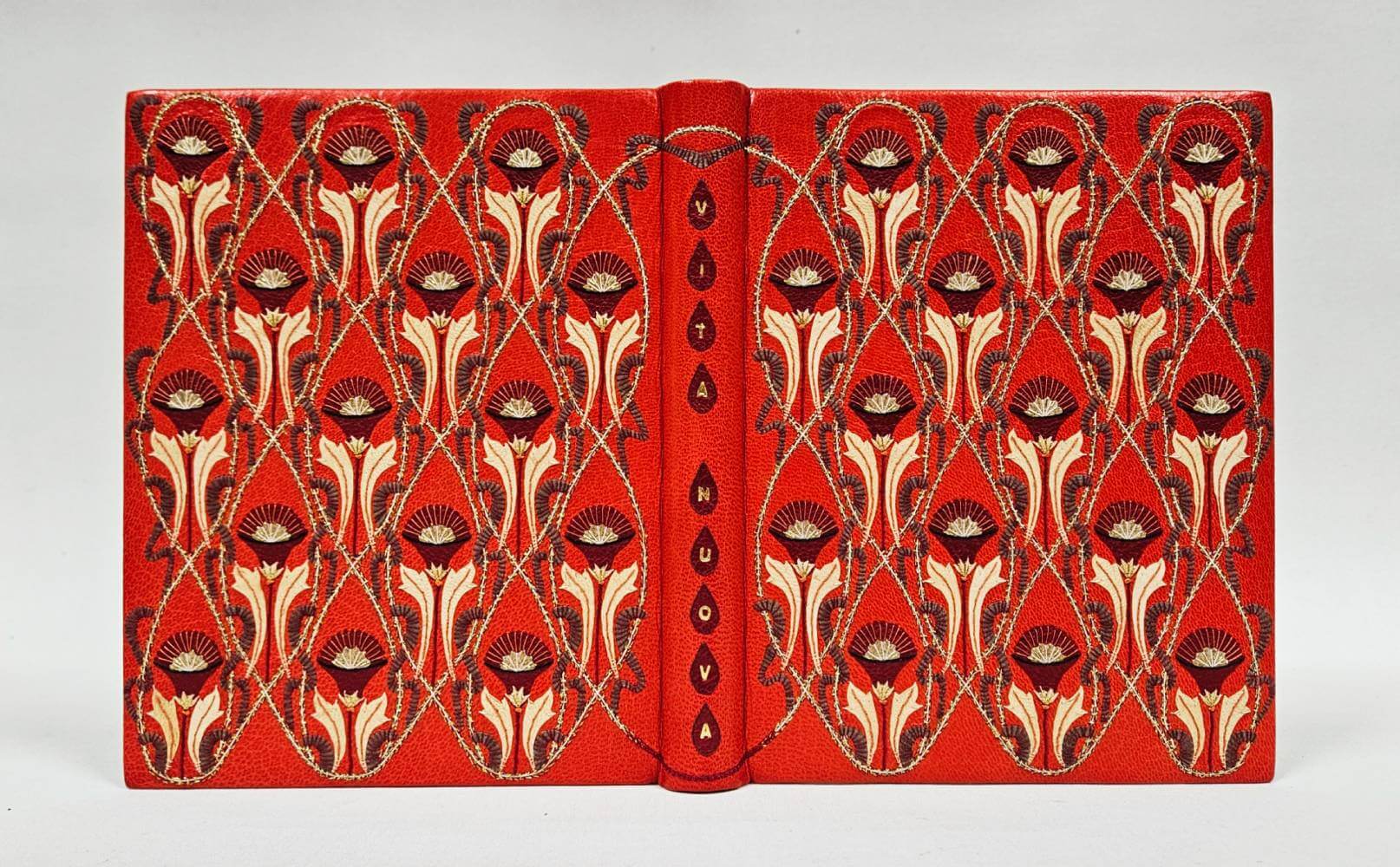
- A full leather stub-binding bound in bright red leather.
- The stubs are folded from bright red paper and tooled in carbon.
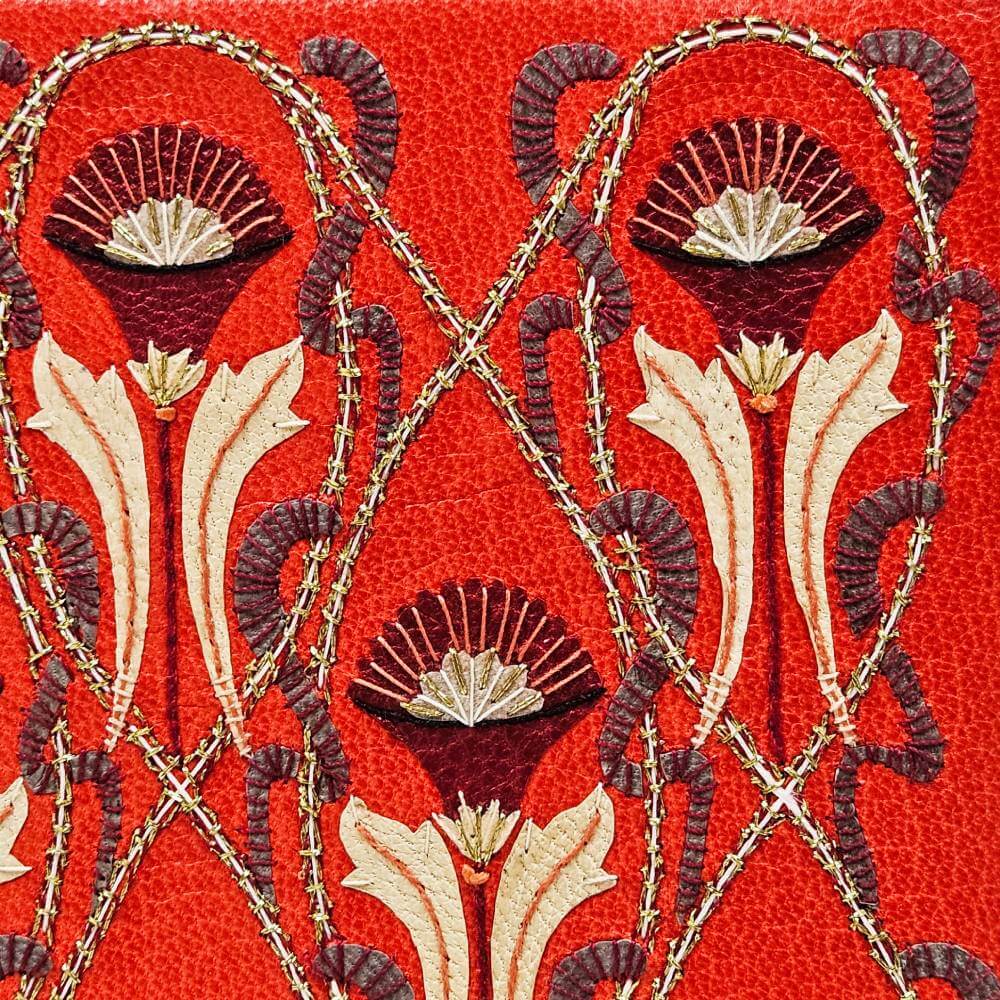
- The covers of the book have intricate embroidered detail, sewn over coloured leather onlays.
- The embroidery stitches include: French knots; running stitch; whipped stitch; couching and seed stitch.
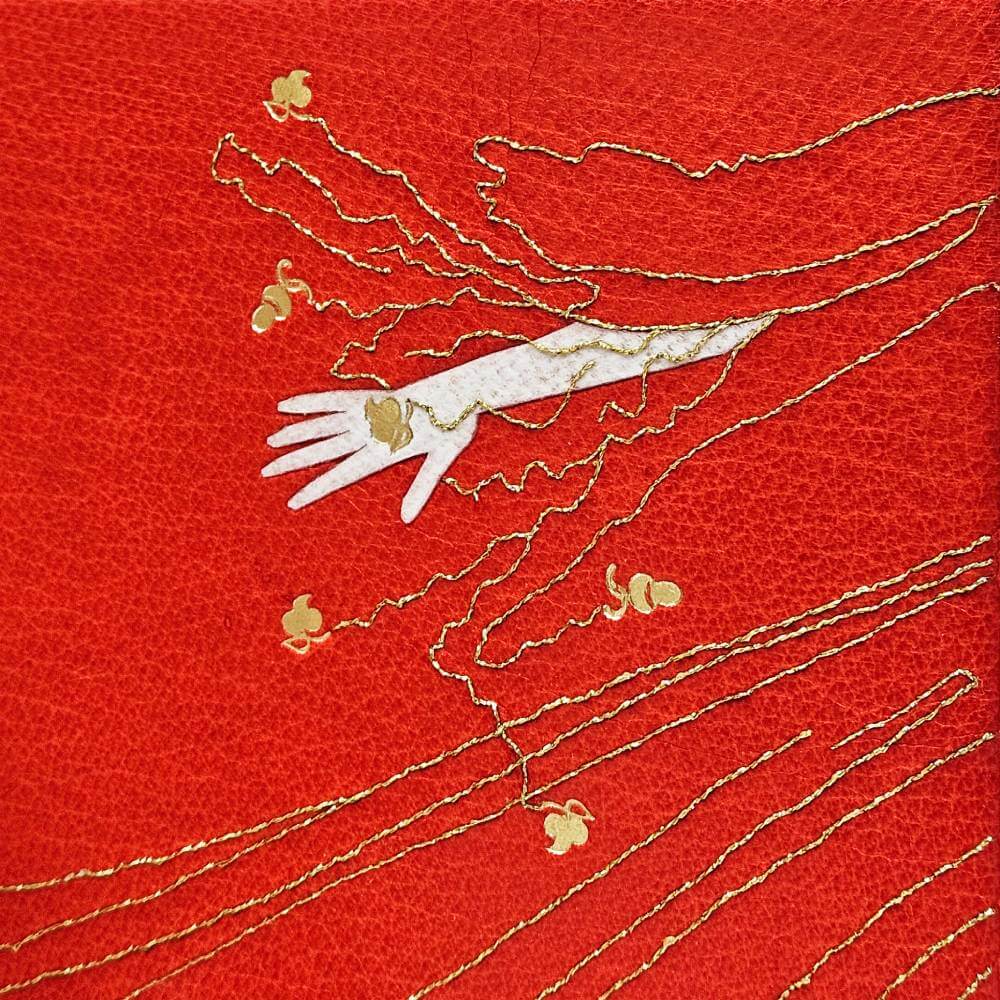
- Edge-to-edge bright red leather doublures , patterned with gold thread and gold tooling and a single vellum onlay.
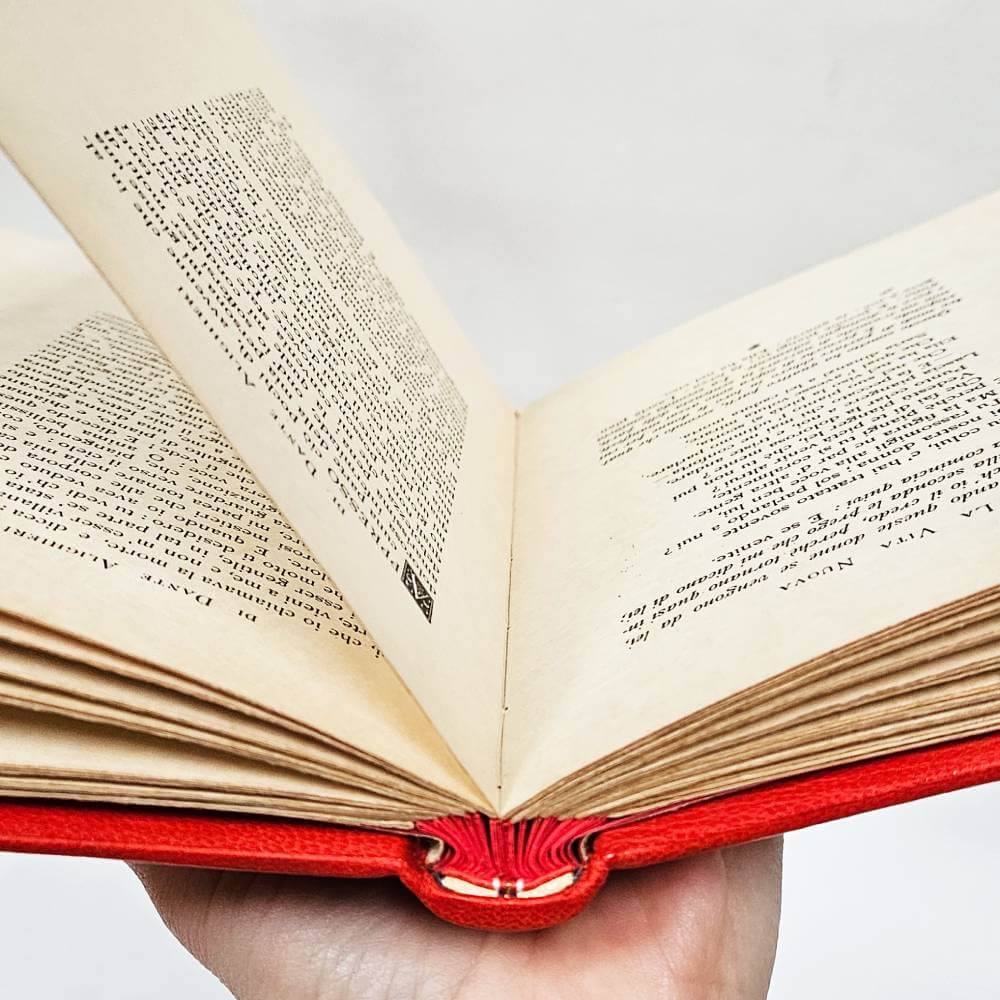
- Leather-jointed endpapers.
- Double-core leather covered endbands with additional thread detail.
- Spine tooled with handle letters.
- The book is housed is an oak box, with a hinged panel in the base under which sits the original book cover.




Design Description:
The outer covers of this binding are decorated with a repeating pattern of Art Nouveau florals, reminiscent of those in vogue during Hornby’s period, with white, grey and burgundy leather onlays to add to the effect. The repeat pattern is only broken across the spine of the binding, where nine droplets flow down from the head to the tail. Each droplet is hand-tooled in 23ct gold leaf to title the book, which is shortened from “La Vita Nuova” to “Vita Nuova” to play on the significance of this number.
Key aspects of the number nine’s significance in La Vita Nuova include:
- Beatrice as a “Miracle” (3×3): Dante explains that because the root of nine is the Trinity (three times three), Beatrice is a miracle sent to earth to bring salvation.
- Encounters with Beatrice: The number nine recurs during crucial moments in their relationship. Dante first sees Beatrice when he is nine years old, and she is at the beginning of her ninth year.
- The Second Meeting: The second encounter with Beatrice occurs exactly nine years after the first, at the ninth hour.
- Death of Beatrice: The number 9 is intertwined with Beatrice’s death, which occurred in the ninth month of the year (June, in the Syrian calendar) and on the ninth day of the month.
- Symbolic Structure: The number 9 also serves to organize the narrative, with many of the poems and events focusing on this number to reinforce the divine nature of his love for Beatrice.
The edge-to-edge doublures of continuous red leather feature gilt thread embroidered into the shape of a fleeing Beatrice’s red dress, its train swirling on the front doublure and the rest floating away from the rear, with only her hand visible as a white vellum onlay. Hornby used two motifs within the printing of the text block which I had tools recreated from to use on the binding; an acorn and a leaf. At the tail end of her flowing dress are multiple hand-tooled impressions in gold foil.
The original front wrapper is preserved under a lift-up panel in the base of an oak box, which has its own label of embroidery and gold tooling on leather to match the spine of the binding.

This book was commissioned by Philip Salmon & Company Rare Books (Boston, Massachusetts), for display on Booth 202 at The Manhattan Rare Book and Fine Press Fair on May 2, 2026 (The Church of St. Vincent Ferrer, 869 Lexington Avenue, New York, USA).
A blog post about how this binding was made will be following soon!